






Books have long been considered the guardians of human civilization, preserving our ideas, stories, and knowledge for thousands of years. From the earliest clay tablets of Mesopotamia to the revolutionary printing press of Gutenberg, the journey of books reflects humanity’s drive to document, communicate, and share wisdom. This article offers a detailed exploration of the first books written and printed by humans, covering their origins, cultural impacts, and technological breakthroughs, with references to authoritative sources for accuracy.
What Defines a “Book”?
Before exploring the first books, it is crucial to define what a book is. Generally, a book is a written or printed work consisting of pages bound together. However, in ancient times, “books” took many forms: clay tablets, papyrus scrolls, and even wooden boards coated with wax. These objects were created to preserve and communicate ideas, much like our modern books.
UNESCO defines a book as a non-periodical printed publication of at least 49 pages, but historically, the word “book” has been applied to anything that records language systematically for reading and reference. Therefore, even a single clay tablet with an epic poem could be considered an ancient book.
The Earliest Written Books: From Clay Tablets to Papyrus Scrolls
Mesopotamia and Cuneiform Tablets
The earliest known writing system emerged in ancient Mesopotamia, around 3400–3000 BCE. Using cuneiform script, Sumerian scribes impressed wedge-shaped marks into wet clay tablets. These tablets recorded trade accounts, laws, hymns, and epic poetry. One of the most famous examples is the Epic of Gilgamesh, written around 2100 BCE. Many scholars consider it the world’s first major literary masterpiece.
Key Points about Mesopotamian Books:
- Cuneiform script enabled long-lasting record-keeping
- Clay tablets were durable and widely used for centuries
- Epic of Gilgamesh preserved cultural and moral lessons
Egyptian Papyrus Scrolls
Meanwhile, ancient Egyptians developed a different method for recording their knowledge. Around 2400 BCE, they began producing papyrus scrolls, made from the pressed stalks of the papyrus plant. Papyrus allowed for longer texts and easier transportation compared to clay. Egyptian priests and scribes used papyrus for religious texts, funerary books (like the Book of the Dead), and governmental archives.
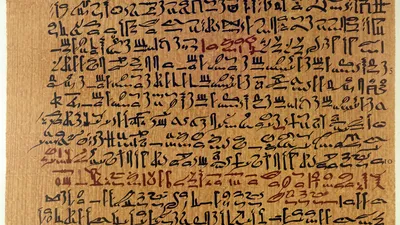
According to the British Museum, thousands of fragments of papyrus texts have survived, giving us insight into daily life, medicine, and spirituality in ancient Egypt.
The Birth of Printing: China’s Pioneering Role
While the handwritten manuscript tradition spread worldwide for centuries, a dramatic innovation changed everything: printing. In China, woodblock printing was developed around the 7th century CE, allowing texts to be copied rapidly and more affordably. Instead of hand-copying each page, artisans carved entire pages into wooden blocks, then inked and pressed them onto paper.
The most famous early printed book is the Diamond Sutra, created in 868 CE. It is a Buddhist scripture printed using woodblocks, and its surviving copy is preserved in the British Library. This book includes a colophon (printer’s note) with a date, making it the earliest known printed book with a precise date in human history.
Key Chinese contributions:
- Woodblock printing in the Tang Dynasty
- Movable-type printing developed later by Bi Sheng (circa 1040 CE)
- Printing promoted literacy and knowledge in East Asia
UNESCO’s Memory of the World program recognizes these Chinese texts as fundamental to world heritage.
Gutenberg and the Movable Type Revolution
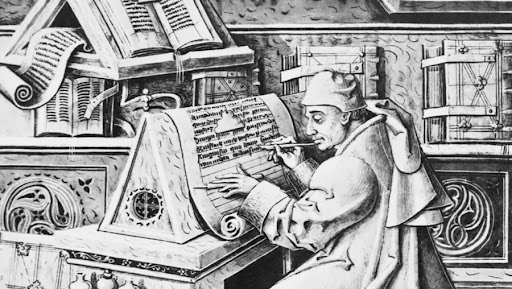
In Europe, book culture was dominated by handwritten manuscripts painstakingly copied by monks in monastic scriptoria. These books were expensive, rare, and often chained to library shelves to prevent theft. That changed dramatically in the 15th century thanks to Johannes Gutenberg of Mainz, Germany.
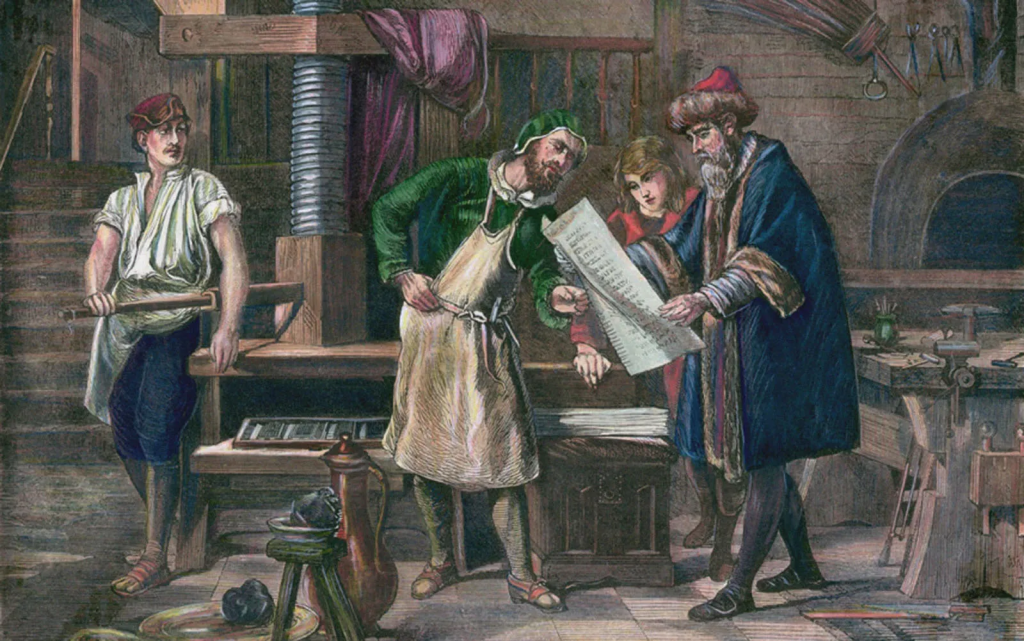
Around 1440, Gutenberg invented the movable-type printing press, using metal letter pieces that could be rearranged and reused for different pages. This was far more efficient than woodblocks, where entire pages had to be carved.
The most iconic product of this press was the Gutenberg Bible, printed circa 1455. It was the first major book printed with movable type in the West, marking the dawn of mass communication in Europe. Experts believe around 180 copies were originally printed, and today fewer than 50 are known to survive.
Why Gutenberg’s work was revolutionary:
- Printing became much faster and cheaper
- Literacy began to spread among the middle class
- Scientific, religious, and political ideas could reach wide audiences
According to the Encyclopaedia Britannica, Gutenberg’s invention was one of the most influential breakthroughs of the second millennium.
Why Early Books Were So Transformative
For centuries, knowledge had been the privilege of a select few: priests, scholars, and rulers. Early books — whether handwritten scrolls or printed texts — dramatically changed this. They helped:
- preserve stories for future generations
- spread religious and philosophical beliefs
- record laws and legal systems
- standardize education
- stimulate science, mathematics, and astronomy
These first books laid the groundwork for what we now call the knowledge economy.
Have a look at this articles too: How the Wealthy Think? 10 Mindset That Leads to Great Wealth.
Impact on Religion, Science, and Society
Books had a profound influence on religious movements. In Europe, the Gutenberg Bible made Christian scripture more accessible. Likewise, in China, printed Buddhist sutras and Confucian texts shaped moral and social systems for centuries.
Scientific progress also accelerated. For example, the works of Euclid and Galen were copied, translated, and printed, becoming standard reference books. The mass production of books during the Renaissance sparked revolutions in astronomy, medicine, and engineering.
Politically, books allowed for the spread of new ideas, fueling movements such as the Reformation in Europe or the later democratic revolutions. Once people could read and debate texts for themselves, centralized authorities found it harder to control the flow of ideas.
Preservation of the First Books Today
Many of these earliest books still exist, thanks to careful preservation:
- The Diamond Sutra is in the British Library
- Several cuneiform tablets are held in the Louvre Museum and the Iraq National Museum
- Surviving copies of the Gutenberg Bible can be viewed in institutions such as the Library of Congress, the British Library, and the Gutenberg Museum in Mainz
Modern technologies, including digital scanning and 3D modeling, are helping researchers study these artifacts without further damaging them. UNESCO’s Memory of the World program is actively working to safeguard these irreplaceable documents.
Conclusion
From ancient Mesopotamian clay tablets to the papyrus scrolls of Egypt, from China’s woodblock-printed sutras to Gutenberg’s printed Bibles, the story of the first books is a testament to humanity’s desire to preserve and share knowledge. These early texts changed history by democratizing information, breaking down barriers between classes, and inspiring revolutions in thought and technology.
Understanding these milestones helps us appreciate the tremendous legacy of the written word, which continues to shape our lives in the digital age. Books remain among humanity’s greatest inventions, bridging cultures and generations.
If you want to dive even deeper, you can explore the digital archives of the British Library, the UNESCO Memory of the World program, or the Gutenberg Museum, which all provide excellent resources for further reading.
Sources for further study: