

![Earn Crypto: The Ultimate Guide to Online Income with Digital Currency Payments [ E-book 2024 ]](https://digitfile.com/wp-content/uploads/2024/03/7.webp)
![Successful Investment: Mastering the Art of Financial Growth [ e-book 2024]](https://digitfile.com/wp-content/uploads/2024/03/71.webp)


AI image prompt writing is quickly becoming a must-have skill for digital creators, designers, and content producers. With the rise of powerful AI tools like Midjourney, DALL·E, and Stable Diffusion that can generate visuals from just a few lines of text, it’s easy to assume that anyone can create great images. But the truth is, your results depend heavily on how well you write your prompts.
This article explores what AI image prompt writing is, why it matters, and how mastering it can elevate your creative output—whether you’re an artist, marketer, or simply curious about AI art.
What Is Prompt Writing in AI Image Generation?
At its core, prompt writing is the act of giving the AI specific instructions about what you want it to generate. The model then “interprets” your words to construct an image that reflects your description. But AI doesn’t think like a human. It doesn’t fill in blanks or read between the lines. You have to be specific and strategic.
A vague prompt like:
➡️ “a woman in a field”
…might generate a passable result.
But a detailed prompt like:
➡️ “a woman in a flowing red dress standing in a golden wheat field at sunset, soft backlight, cinematic composition, captured on a 50mm lens”
…produces a significantly richer and more accurate visual.

Why Prompt Writing Is a Skill, Not a Shortcut
Many new users expect magical results by typing a few random words. While the tech is impressive, AI still relies entirely on your input. Poorly structured or unclear prompts often lead to distorted or unrelated images.
That’s why AI image prompt writing has evolved into a true creative skill—some even call it a new form of visual storytelling.
The better your grasp of style, visual language, composition, and descriptive writing, the more control you’ll have over the final image.
Key Components of Effective AI Image Prompt Writing
To master this skill, focus on these essential elements:
- Style and Genre
Decide early: Should the image be photorealistic? Cartoonish? Impressionistic? Mention keywords like digital painting, oil painting, anime, or 3D render to set the tone. - Subject and Details
Describe your subject clearly. Don’t just say “a man”—say “an elderly man with a long white beard, wearing a wide-brimmed hat and a dark cloak.” - Lighting and Mood
Use terms like golden hour, neon-lit, moonlight, or studio lighting to shape the mood. - Composition and Perspective
Add details such as close-up, aerial view, portrait orientation, or centered composition to control the framing. - Environment and Texture
Enhance the setting: “foggy mountain landscape,” “rusty metal texture,” or “polished marble floor.” These details bring the image to life.
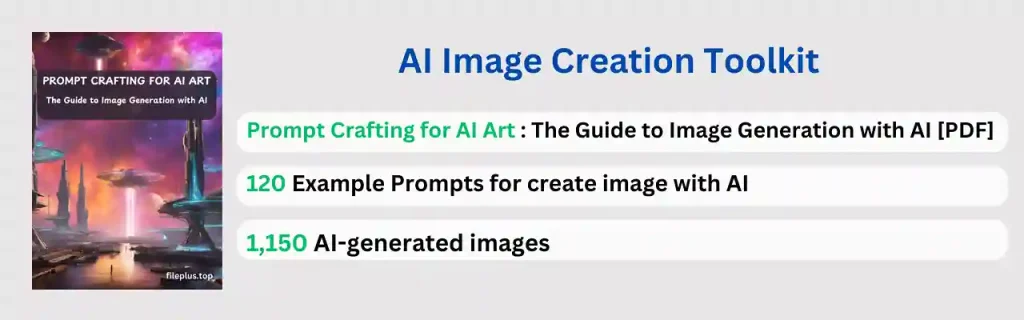
AI Image Creation Toolkit: Master Image Generation with 120 Prompts and 1,150 Unique AI Images
Learning Through Structure, Not Just Trial-and-Error
While experimenting is valuable, it can also be overwhelming. You might spend hours tweaking phrases and still not get what you want. That’s why curated learning tools, templates, and categorized prompt libraries have become increasingly popular among creators.
Some creators benefit from structured resources that:
- Break down prompt anatomy by visual style
- Provide plug-and-play examples
- Offer best practices for different platforms (like Midjourney vs. DALL·E)
These toolkits help shorten the learning curve, saving time while improving consistency in results.
Final Thoughts
In the age of AI, your words are your paintbrush—and prompt writing is how you wield it. AI image prompt writing empowers you to turn imagination into tangible visuals, but like any art form, it requires practice and technique.
Whether you’re building a brand, designing concept art, or simply exploring AI creativity, strong prompts are your foundation. The better you get at it, the more the AI feels like an extension of your vision—not just a random generator.
And if you ever feel stuck, remember: behind every great AI image is a great prompt.